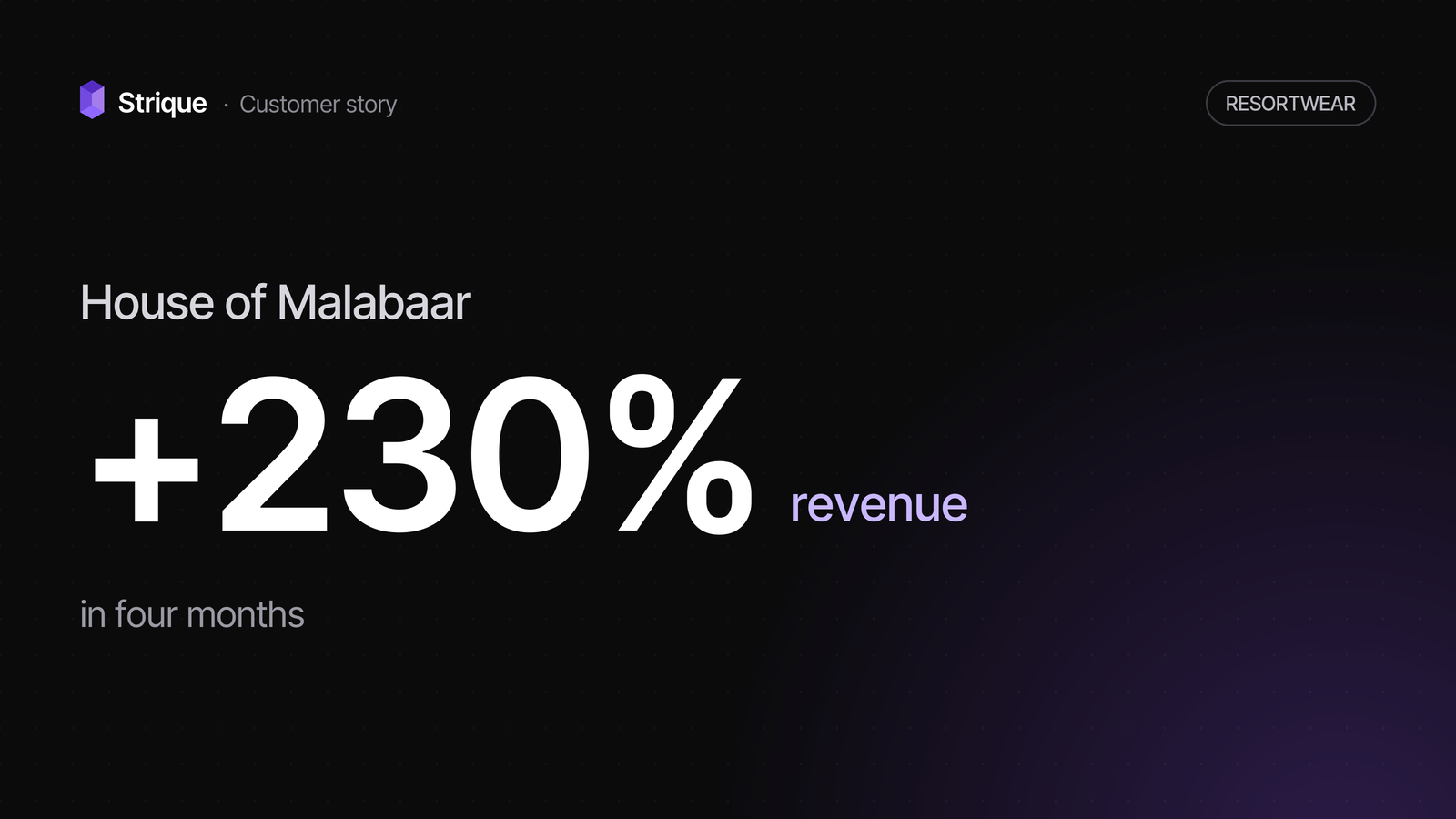
+0%
Monthly revenue in 4 months
0.00
ROAS (up from 2.00)
+0%
Website conversion
0%
Multi-product orders (from 9%)
House of Malabaar does not sell something people buy every week. It sells for a moment: a beach holiday, a resort weekend, a family trip worth dressing for.
That makes growth tricky. Demand is real but arrives in windows. Wait until someone searches for swim shorts and most of the journey has already happened. Advertise too early without an occasion and the product is pretty content with no urgency.
Strique rebuilt the account around those moments. Within four months monthly revenue grew from ₹8.4 lakh to ₹27.72 lakh, up 230%, while spend grew 74%. Revenue grew more than three times faster than spend.
The catalogue was organised by category. Customers shop by occasion.
Swimwear, linen shirts, shorts, loungewear, boyswear and father-and-son styles are separate collections on the merchandising sheet. To a customer they can all belong to the same trip. Running each as its own campaign splits the budget and makes the shopper assemble the holiday alone.
Strique changed the planning question from 'which category do we push this week?' to 'which moment is coming up, and what does that shopper need from discovery to checkout?'
A demand calendar built around life outside the wardrobe
- Beach or resort holiday: start with swim shorts, expand to linen shirts and pants. 'Pack a complete resort wardrobe.'
- Summer weekend: linen and terry, coordinated separates. 'Look polished without dressing heavy.'
- Family travel: men's and boys' swimwear, father-and-son sets. 'A shared holiday moment.'
- Slow mornings and evenings: loungewear, mix-and-match sets. 'Comfort that still feels considered.'
- Destination celebrations: tailored swimwear and linen, full looks. 'Ready for the events around the event.'
Long weekends, school holidays, wedding travel, weather and departure dates all feed the calendar. Discovery builds desire around the trip, product ads catch the category a shopper is already weighing, and retargeting completes the wardrobe instead of repeating the same item. One story, told at different levels of intent.
The delivery clock became part of conversion
House of Malabaar's typical processing and delivery window is five to seven business days. A shopper buying for a trip is really asking one thing: will it arrive before the suitcase closes? Strique planned media around that window:
- Early discovery introduces the trip before people finalise what to pack.
- Consideration brings in fabric, fit and styling while there is time to choose.
- High-intent retargeting focuses on the exact collection the shopper explored.
- Delivery-aware suppression pulls spend once an order can no longer arrive in time.
Less money went to shoppers the brand could not serve, and fewer customers got promises the operation could not keep. In a seasonal business that is performance marketing, not logistics.
The landing page continues the trip
A family-beach-holiday ad should not drop someone onto a page with hundreds of products. Swimwear campaigns lead with trip-relevant prints, family campaigns put father-and-son styles up front, linen campaigns show a coordinated resort wardrobe, and retargeting remembers the pattern and occasion already viewed. Website conversion rose from 0.72% to 1.24%.
One moment, a bigger basket
Strique recommended the next item based on the trip, not on generic bestsellers. Swim shorts lead to a linen shirt for the same holiday. A father shopping for himself finds the boys' version. Multi-product orders went from 9% to 24% and AOV from ₹5,250 to ₹6,480. Free shipping and the prepaid incentive became part of the journey instead of checkout footnotes, and prepaid orders rose from 31% to 49%.
Four months on Strique
- Baseline: category-led campaigns, disconnected journeys. ₹8.4L/month.
- Month 1: demand mapping, clean measurement, moment-level account structure. ₹11.6L.
- Month 2: matched landing journeys and travel-window sequencing. ₹16.4L.
- Month 3: basket expansion, father-and-son paths, lifecycle. ₹21.9L.
- Month 4: budget expansion across proven moments. ₹27.72L.
ROAS went from 2.00 to 3.43 and CAC fell 26%. Direct, assisted and returning revenue grew from ₹2.2 lakh to about ₹9.2 lakh a month. That is how 74% more spend turned into 230% more revenue.