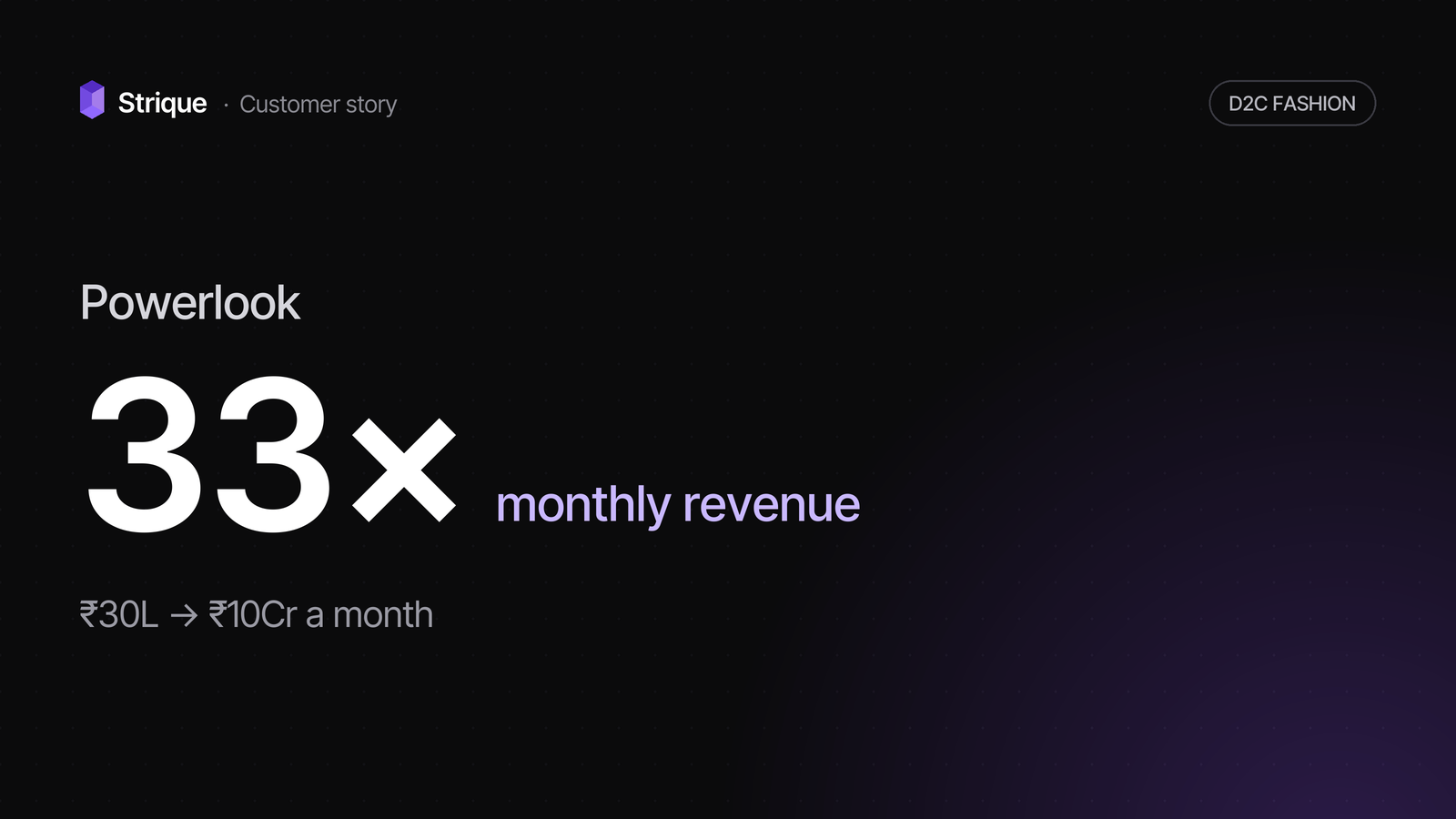
0x
Monthly revenue (₹30L → ₹10Cr)
-0%
Customer acquisition cost
0+
Creatives shipped per week
+0%
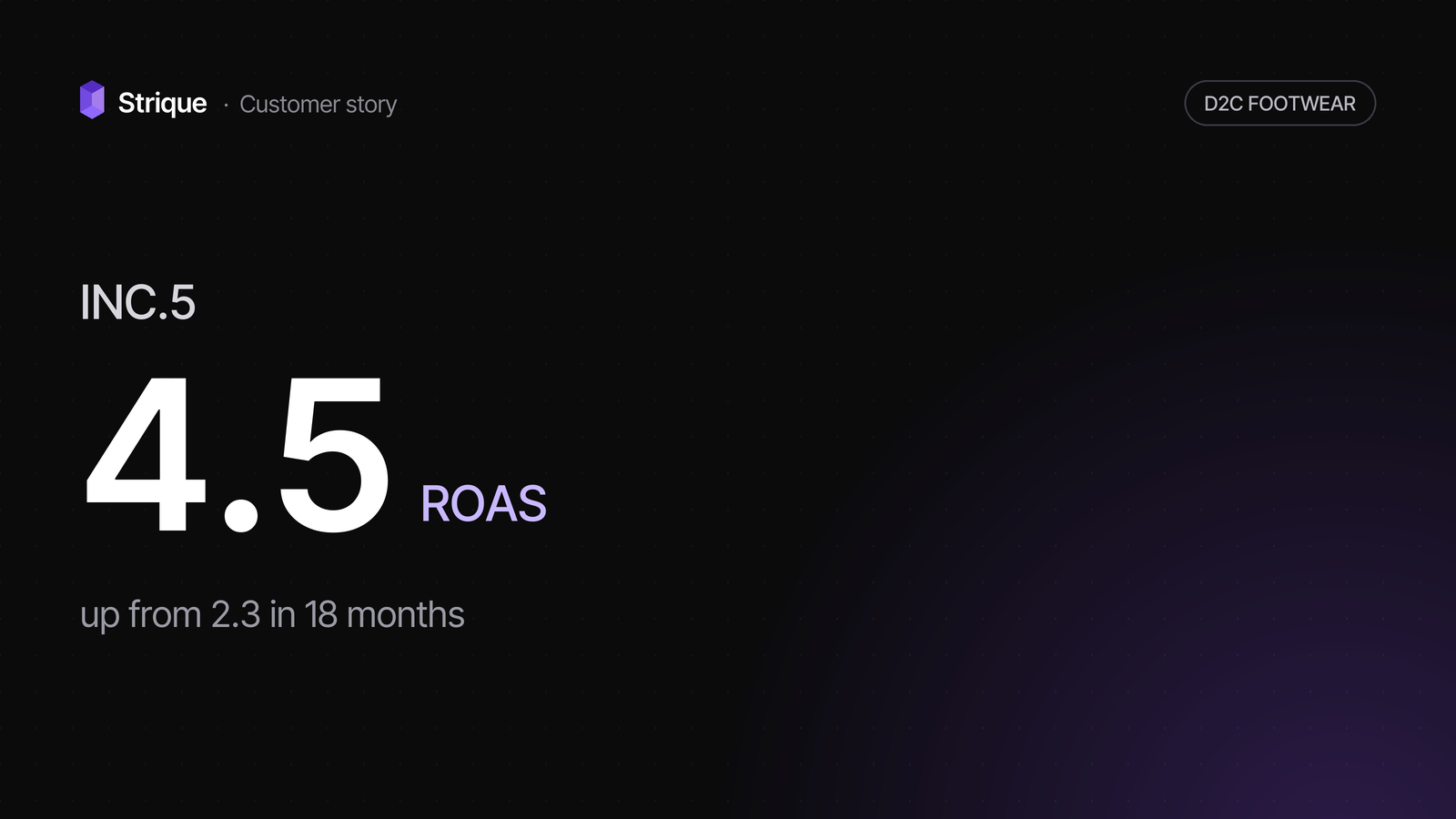
ROAS, Q2 2026
In 2021 Powerlook was doing about ₹30 lakh a month. Today it does about ₹10 crore. That is a 33× jump in monthly revenue, and a move from a ₹3.6 crore annual run rate to ₹120 crore.
The more useful story is what had to change underneath the number. At ₹30 lakh a month, marketing can run on effort. At ₹10 crore, it needs a system that reads its own results and acts on them while campaigns are still live.
Run by Digimaze, powered by Strique
Digimaze is Strique's performance marketing arm: 200+ specialists running paid media, SEO, creative and marketplaces for 250+ brands. Every Digimaze account runs on Strique, which reads campaign data across channels, surfaces what changed and turns hours of analysis into a same-day decision. Digimaze's team and the brand read from the same numbers.
Digimaze has run Powerlook since 2021. The early problem was expensive acquisition and inconsistent lead quality, so the first job was making every rupee of media work harder. Strique split men's fashion into tighter audience segments, tested creative continuously, and brought influencer-led content into the test mix to find which products looked credible outside studio photography.
- Customer acquisition cost fell 60%.
- Brand awareness rose 150%.
That gave Powerlook room to scale. Scale then exposed the next constraint.
The bottleneck moved from media to time
Powerlook runs 200+ SKUs across six categories. Products move fast, demand shifts fast, and creative wears out fast. The in-house team could make 8 to 10 creatives a week, which meant too many products competing for too few tests. By the time fatigue showed up in a weekly report, the money had already been spent.
Strique's creative agent took output past 40 pieces a week. Fatigue detection flags and retires underperformers every 72 hours, and the strongest visual patterns carry straight into the next batch while the signal is still fresh. Four times the content meant four times the chances to learn.
'Two weeks used to feel fast for a campaign build. Now 48 hours feels slow.' Head of Performance, Powerlook
Closing the gap after the click
More creative only solved half of it. Powerlook also needed a tighter path from registration to first purchase, so Strique generated landing-page variants and lifecycle flows aimed at that exact gap. Every campaign was judged on whether its traffic became a customer, and that result fed the next creative and budget decision.
The account now runs as one loop across Meta, Google Shopping and YouTube:
- Ship more creative.
- Read the response.
- Retire what is fading.
- Put weight behind what converts.
- Carry the learning into the next launch.
The first 60 days, including the number that went down
- Revenue: +72%
- User registrations: +62%
- New-user conversion: +54%
- ROAS vs. the previous baseline: −9%
We keep the last line in because it is true. Powerlook was spending into a bigger audience and absorbing the cost of scale. The test is whether the system learns fast enough to recover without shrinking back, and it did: by Q2 2026, Powerlook's ROAS was up 48%.
What runs on Strique now
- Audience and message combinations instead of broad paid reach.
- 40+ creatives a week, up from 8 to 10.
- Fatigue calls every 72 hours instead of every review cycle.
- Landing-page and lifecycle tests tied to first purchase, not registration.
- Evergreen acquisition on Meta, Google Shopping and YouTube with no extra hires.
Powerlook's growth also owes a lot to product, merchandising, retail and the founders' calls. The brand that started at ₹30 lakh a month now has stores across Mumbai, Bangalore, Vadodara, Ahmedabad, Indore, Pune and Surat. Strique's part was making sure marketing never became the thing that slowed it down.