0.00
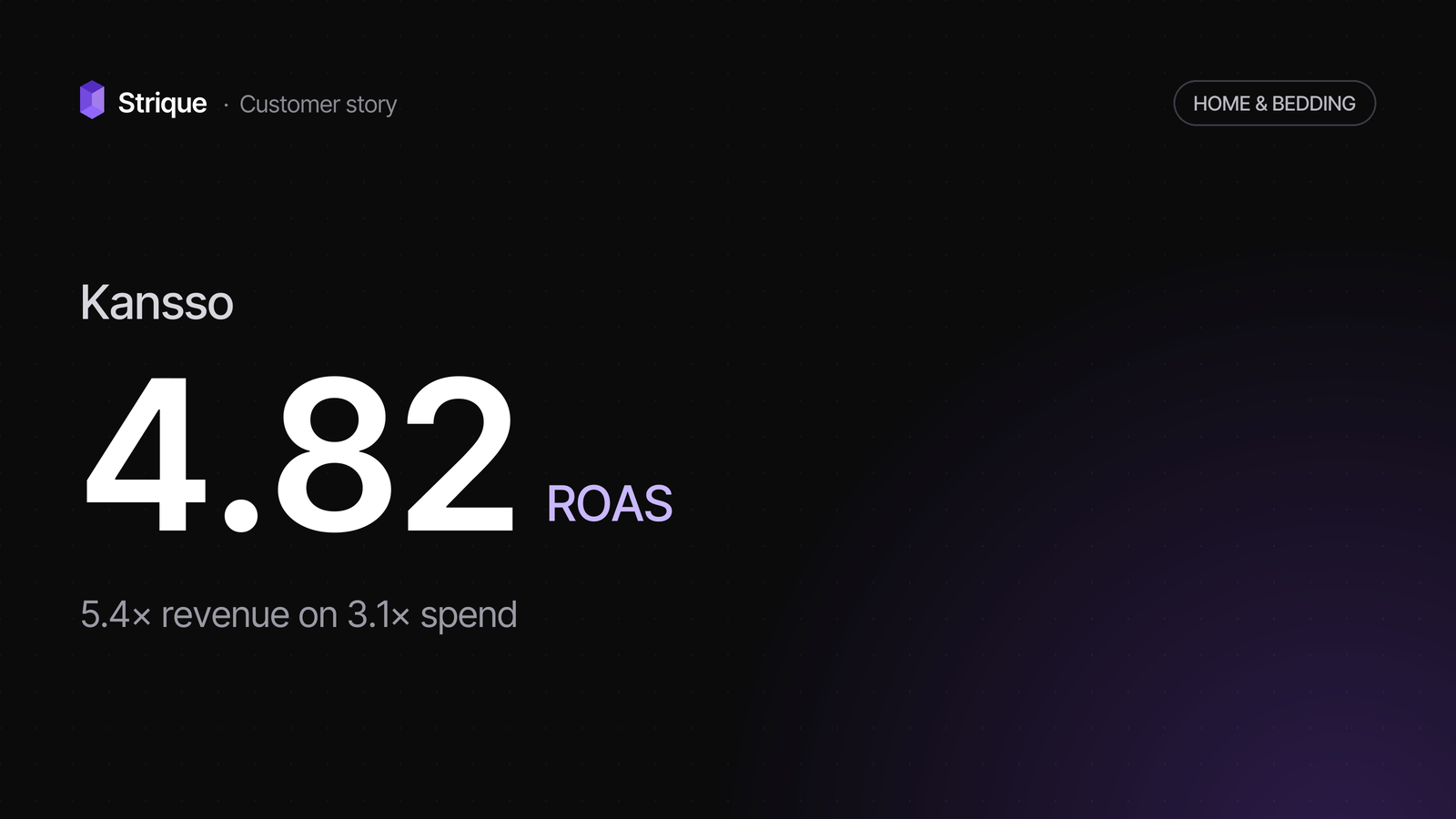
ROAS (up from 2.71)
+0%
Attributed monthly revenue
-0%
Customer acquisition cost
+0%
Average order value
Kansso sells something everyone understands and almost nobody knows how to choose. Nobody wakes up wanting 300-thread-count percale. They want to sleep cooler, make the bedroom feel nicer, or buy sheets that survive the wash.
Over 18 months on Strique the account went from 2.71 ROAS to 4.82. Monthly spend grew from ₹8.5 lakh to ₹26 lakh, and attributed monthly revenue grew from ₹23 lakh to ₹1.25 crore. Revenue grew 5.4× on 3.1× the spend.
Demand was never the problem. Knowing which demand to fund was.
Kansso's product line is clear: Luxe is a soft 600-thread-count sateen, Hotel is a crisp, breathable 300-thread-count percale for hot sleepers. Inside the ad account that distinction got lost. Broad bedding campaigns sold, but they could not answer the questions that matter once you try to spend more:
- Is this high-ROAS campaign selling the right collection, or just clearing the easiest colour and size?
- Are we acquiring a valuable customer or discounting to someone who would have bought anyway?
- Should the next rupee go to the best click-through rate, the best margin or the deepest stock?
- Is the campaign still profitable after discounts, payment costs, fulfilment and returns?
While those answers lived in separate reports, scaling was a negotiation between marketing, merchandising and inventory. Strique put them in one place.
Campaigns built around sleep, not jargon
- Sleeps hot → Hotel Percale: crisp, breathable bedding for a cooler night.
- Wants softness → Luxe Sateen: smooth, cosy sheets with a richer hand-feel.
- Refreshing a bedroom → sheet sets and coordinated colours.
- Building a full bed → sheet, duvet and pillowcase combinations.
A hot sleeper who clicks no longer lands on a generic bedding page and has to decode thread counts alone. The ad, collection page, product copy and follow-up all carry the same message, so shoppers recognise the right product before they start comparing.
A budget system that works at product level
Most dashboards tell you which campaign made money. Strique goes a level deeper. Every meaningful mix of collection, product, audience, creative angle and landing page is a decision cell, scored on four signals:
- Demand: how efficiently it drives qualified traffic and orders.
- Contribution: whether the sale is still worth it after discounts and variable costs.
- Stock depth: whether there is inventory in the sizes and colours people pick.
- Basket effect: whether it ends at one item or opens up a bigger set.
That stops a classic ecommerce mistake: scaling yesterday's winner into tomorrow's stockout. If a Hotel Percale colour takes off but king-size stock tightens, Strique pulls spend on that exact combination without switching off the whole collection, and moves it to in-stock colours, Luxe, or a bigger set while the signal is still useful.
The question changed from 'which campaign won?' to 'where does the next rupee earn the most?'
Bigger baskets bought room to acquire
Kansso's range lets people build a complete bed, but most journeys ended with one sheet set. Strique used product affinity and cart behaviour to find what people buy together, then carried that context from the first ad through on-site merchandising and into retargeting. A Hotel Percale shopper sees a matching duvet cover, not a generic discount.
Multi-product orders rose from 13% to 31%. AOV rose from ₹4,950 to ₹6,260. With more value per order, Strique could bid for stronger audiences and still cut CAC from ₹2,460 to ₹1,730.
18 months on Strique
- Months 1–3: clean measurement and a product-level baseline. ROAS 2.71.
- Months 4–8: sleep-intent campaigns and matched landing journeys. ROAS 3.35.
- Months 9–13: bundles, basket expansion and lifecycle segments. ROAS 4.10.
- Months 14–18: margin- and inventory-aware scaling. ROAS 4.82.
Across the full 18 months that is ₹3.06 crore in spend and ₹12.66 crore in attributed revenue, a blended ROAS of 4.14. Kansso did not need more reporting. It needed the ad account, the catalogue and the economics of an order to speak the same language.