On this page⌄
- What counts as ad waste in performance marketing in 2026?
- Common sources of advertising waste that marketers overlook
- The metrics that show waste (ad tracking + ad monitoring)
- What an AI analytics platform should include for ad performance
- Essential features for ad analytics and ad optimization
- Warning signs of marketing analytics programs that don't cut waste
- How the game is being altered by chat-based marketing platforms
- Clicking on dashboards vs. requesting results
- The true key to improving ad performance is chat-based execution
- How AI ads procedures are made simpler by Strique AI (prompt, insights, execution)
- Pain point 1: Slow reporting combined with dispersed data
- Pain point 2: Uncertainty about the source of ad waste
- Pain point 3: Misallocation of funds
- Pain point 4: Slow iteration combined with creative exhaustion
- Pain point 5: Testing without a system
- Pain point 6: Launch overhead plus manual setup
- Pain point 7: Reactive management
- Strique AI vs. traditional marketing analytics tools
- Best practices: cutting down on ad waste with AI ad analytics
- Quit reporting on ad waste and begin getting rid of it
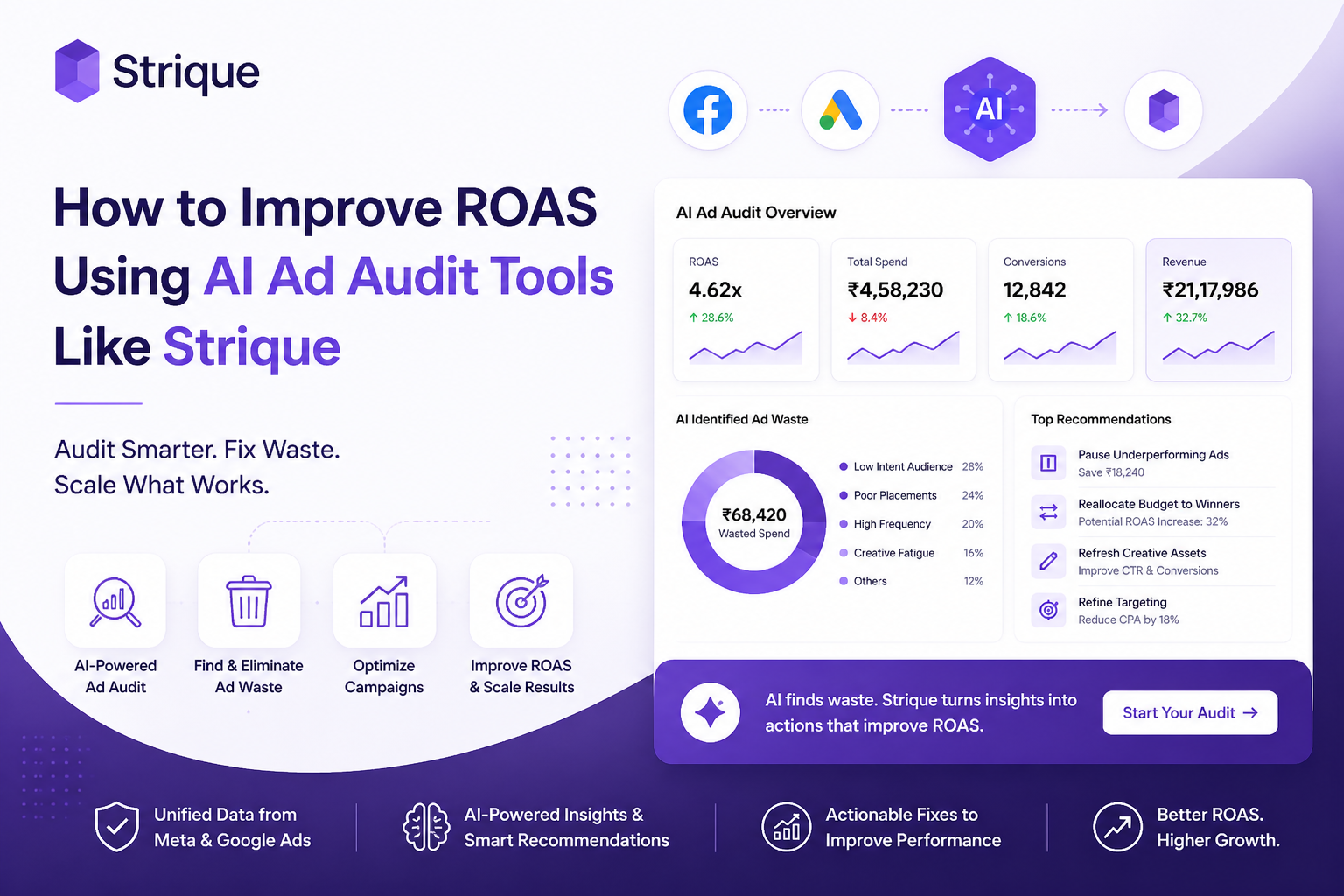
Rising CPMs are not the only threat to profitable paid media in 2026. Weak targeting, creative fatigue, bad placements, budget misallocation, and broken attribution signals across Meta and Google are the causes of this unseen ad waste.
The majority of brands attempt to address this by increasing the number of dashboards. However, dashboards do not address action delays; they merely improve visibility. Performance has already declined by the time a team finds wasteful spending.
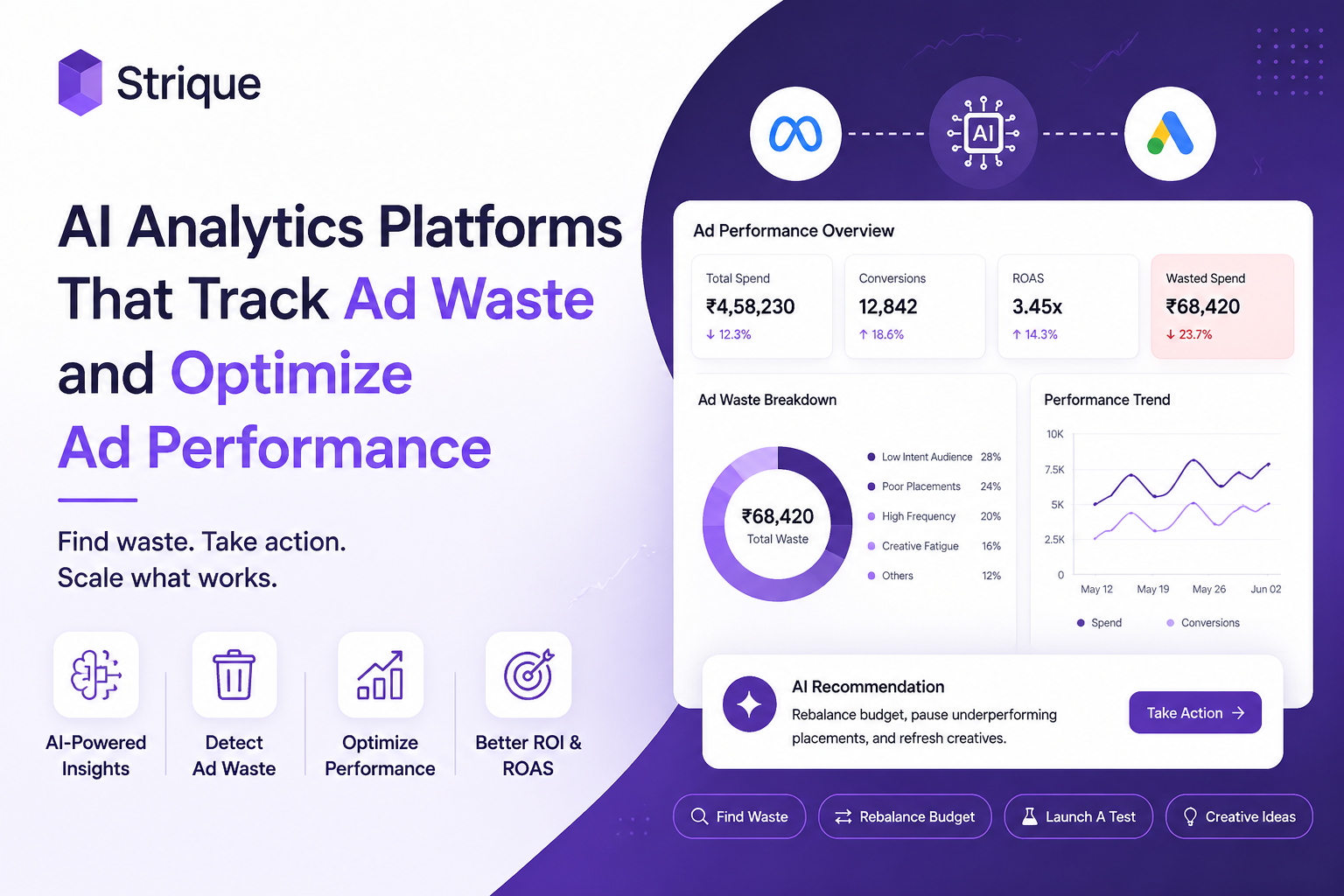
This is when the workflow is altered by a modern AI analytics platform. It finds inefficiencies, prioritizes fixes, and assists teams in completing ad optimization more quickly rather than just reporting data.
This is transformed into a chat-based execution layer by Strique AI, which makes it unique. Marketers can get from insight to action in a minute by promoting outcomes like "find wasted spend," "rebalance budget," or "launch a test" rather than browsing through tabs.
What counts as ad waste in performance marketing in 2026?
Common sources of advertising waste that marketers overlook
The following are the most often disregarded causes of ineffective AI ads:
- Low-intention audiences
- Weak geographical areas
- Inadequate placements
- Fatigue from excessive frequency
- Decay of creative CTR
- Stale remarketing pools with high CPA
- Monitoring discrepancies between platform and real earnings
When these layers are not regularly examined, even effective advertisements might subtly lose effectiveness.
The metrics that show waste (ad tracking + ad monitoring)
The most effective procedures for tracking and monitoring ads concentrate on:
- CPA
- CAC
- CTR
- CVR
- Trends in CPM/CPC
- Frequency
- Breakdowns in positioning
Waste manifests itself differently in prospecting and retargeting. While retargeting waste manifests as oversaturation and increased frequency, prospecting frequency leaks through broad segmentation.
What an AI analytics platform should include for ad performance
Essential features for ad analytics and ad optimization
The following should be part of the ideal ad analytics stack:
- Google and Meta combined visibility
- Automated waste identification
- Constant advice alerts
- The identification of anomalies
- Advice on A/B testing
- Workflows for action-ready optimization
- Insights from a creative refresh
Actionability is the primary differentiator. A robust platform ought to do more than just report waste. It should suggest what should be put on hold, where budgets should be moved, and which creatives should be updated.
Warning signs of marketing analytics programs that don't cut waste
A lot of marketing analytics tools are still limited to reporting. Common gaps consist of:
- CSV exports
- Dependency on manual spreadsheets
- No prioritized recommendations
- No workflow execution
- Postponed daily reporting
- Inadequate original ideas
Optimization is still sluggish if the tool displays the issue but not the next course of action.
How the game is being altered by chat-based marketing platforms
Clicking on dashboards vs. requesting results
The new process is outcome-driven. Rather than exploring reports and filters, marketers may just ask:
- Identify wasteful spending
- Examine Meta and Google
- Display the dangers of weariness
- Suggest changes to the budget
- Start a creative experiment
For agencies and e-commerce teams handling numerous accounts, this lower decision friction speeds up ad performance management.
The true key to improving ad performance is chat-based execution
Execution is the true benefit. The process turns into:
- Analysis
- Suggestion
- Execution
- Observation
This bridges the gap between understanding and action, which is where the majority of wasteful spending typically accumulates.
How AI ads procedures are made simpler by Strique AI (prompt, insights, execution)
Pain point 1: Slow reporting combined with dispersed data
Prompt: "Summarize the last seven days' performance across Meta and Google by campaign."
Strique compares channels, unifies ad analytics, and reveals changes in trends. Faster reporting and action loops are the outcome.
Pain point 2: Uncertainty about the source of ad waste
Prompt: "Where are we wasting this week?"
Set priorities based on impact by marketing, placement, audience, and keyword clusters. The platform finds waste. As a result, high-impact budget recovery is given immediate attention.
Pain point 3: Misallocation of funds
Prompt: "Rebalance budgets to protect ROAS and reduce CPA."
Strique uses scaling and pacing logic to shift spending in favor of winners. Stronger efficiency and quicker ad optimization are the outcomes.
Pain point 4: Slow iteration combined with creative exhaustion
Prompt: "Create ten new ad angles for our best seller."
It offers angles; stale creatives cause fewer performance declines.
Pain point 5: Testing without a system
Prompt: "Make an A/B test roadmap for audience vs. creative."
It uses rollout logic to construct hypothesis-driven testing plans. Faster experimentation and organized learning are the outcomes.
Pain point 6: Launch overhead plus manual setup
Prompt: "Create a Meta prospecting campaign for X budget."
Strique creates launch checks and campaign structures. Faster launches and fewer setup errors are the outcome.
Pain point 7: Reactive management
Prompt: "Notify me if CPA increases by 20% every day."
By using anomaly-based notifications, this enhances ad monitoring. Fewer unexpected performance declines are the outcomes.
Strique AI vs. traditional marketing analytics tools
When it comes to data warehousing, organized reporting templates, and visualization, traditional marketing analytics technologies are excellent. They assist teams in organizing performance data and analyzing past marketing trends. Their greatest drawback, though, is that optimization still relies on manual interpretation, spreadsheet inspections, and dashboard switching before any action is made.
Strique AI adopts a completely new strategy that prioritizes chat. It simplifies the daily workflow to outcome-based reminders rather than requiring marketers to spend the day browsing reports. Because the platform links insights directly to execution, setup is shorter, and cross-channel visibility is unified. Most importantly, optimization proceeds far more quickly. The workflow becomes much more action-oriented, whether it is reallocating funds, finding ad waste, updating creatives, or starting structured tests.
Strique enhances optimization speed, streamlines creative iteration, and transforms performance analysis into an actual decision-making system as compared to conventional marketing analytics tools. Without the delays of dashboard-heavy operations, this prompt-led workflow produces better ad performance gains and speedier clarity for media buyers, e-commerce brands, and agencies managing many accounts.
Best practices: cutting down on ad waste with AI ad analytics
A straightforward weekly schedule:
- Monday: waste scan and budget shifts
- Midweek: test releases and a creative revitalization
- Friday: learning summary and schedule for the following week
Protection to ensure the safety of AI ads optimization. Utilize:
- Caps on budget changes
- Protection during the learning phase
- Holdout reasoning
- Test windows
- Scaling thresholds
These safeguards maintain the effectiveness of ads optimization without causing performance instability.
Quit reporting on ad waste and begin getting rid of it
Faster action, not more reporting, is what will drive AI ad performance in the future. Ad tracking, ad analytics, testing, and budget optimization no longer require a separate platform for the brand. These layers are combined into a single, execution-ready workflow by a robust AI analytics platform, which helps teams advance before performance declines, prioritizes changes, and finds waste.
This is made particularly potent by Strique AI, which converts cues into results. With a single chat-first procedure, marketers can find wasteful spending, rebalance budgets, update creatives, and track without spending all day looking at dashboards. Seeing waste more quickly is not the true competitive advantage. It is getting rid of it before it compounds.
Frequently asked questions
- What is ad waste in paid media?
- Ad waste is spend lost through weak targeting, poor placements, fatigue, budget inefficiencies, or tracking gaps.
- What is the difference between ad tracking and ad analytics?
- Ad tracking captures campaign behaviour, while ad analytics interprets that data into performance insights and optimisation decisions.
- Can an AI analytics platform optimise Meta and Google together?
- Yes. A strong AI analytics platform unifies both channels and recommends budget and creative actions across them.
- How does AI decide what to pause vs scale?
- It uses CPA, ROAS, CTR, CVR, and trend signals to identify waste versus winners.
- Do marketing analytics tools reduce CPA?
- Reporting-only tools may not. Action-oriented AI platforms can reduce CPA through faster optimisation.
- How do I set up ad monitoring alerts?
- Use anomaly thresholds for CPA, CTR, and frequency shifts.
- Is chat-based execution safe for budget changes?
- Yes, when guardrails and approval limits are defined.
- What should agencies prioritise in AI ads tools?
- Cross-account visibility, fast reporting, waste detection, and action-ready workflows.