On this page⌄
- Why ROAS declines in the absence of frequent ad audits
- How AI-driven ad audits increase ROAS more quickly
- How Strique facilitates the implementation of audits
- The most crucial ROAS metrics to audit
- 1. Efficiency of spending to net sales
- 2. The velocity of creative weariness
- 3. Contribution at SKU level
- 4. Leakage of funnels
- 5. Channel overlap
- The best way to use AI audits to increase ROAS
- Step 1: Conduct a thorough account audit
- Step 2: Give budget leaks top priority
- Step 3: Extend lucrative SKUs
- Step 4: Rejuvenate weary creatives
- Step 5: Conduct a weekly audit
- Reducing guessing is now the quickest approach to increase ROAS
These days, increasing return on ad spend involves more than just manually reviewing a few dashboards and adjusting bids. Faster insight into wasteful spending, worn-out creatives, failing SKUs, and broken funnel routes is essential for modern growth teams. For this reason, the development of intelligent ad audits using AI procedures has been strongly linked to how to improve ROAS.
Spreadsheet work involving Meta, Google, GA4, and Shopify can take hours during traditional audits. Performance has already declined by the time teams figure out what is causing the budget leak. By reducing the feedback loop, AI modifies that.
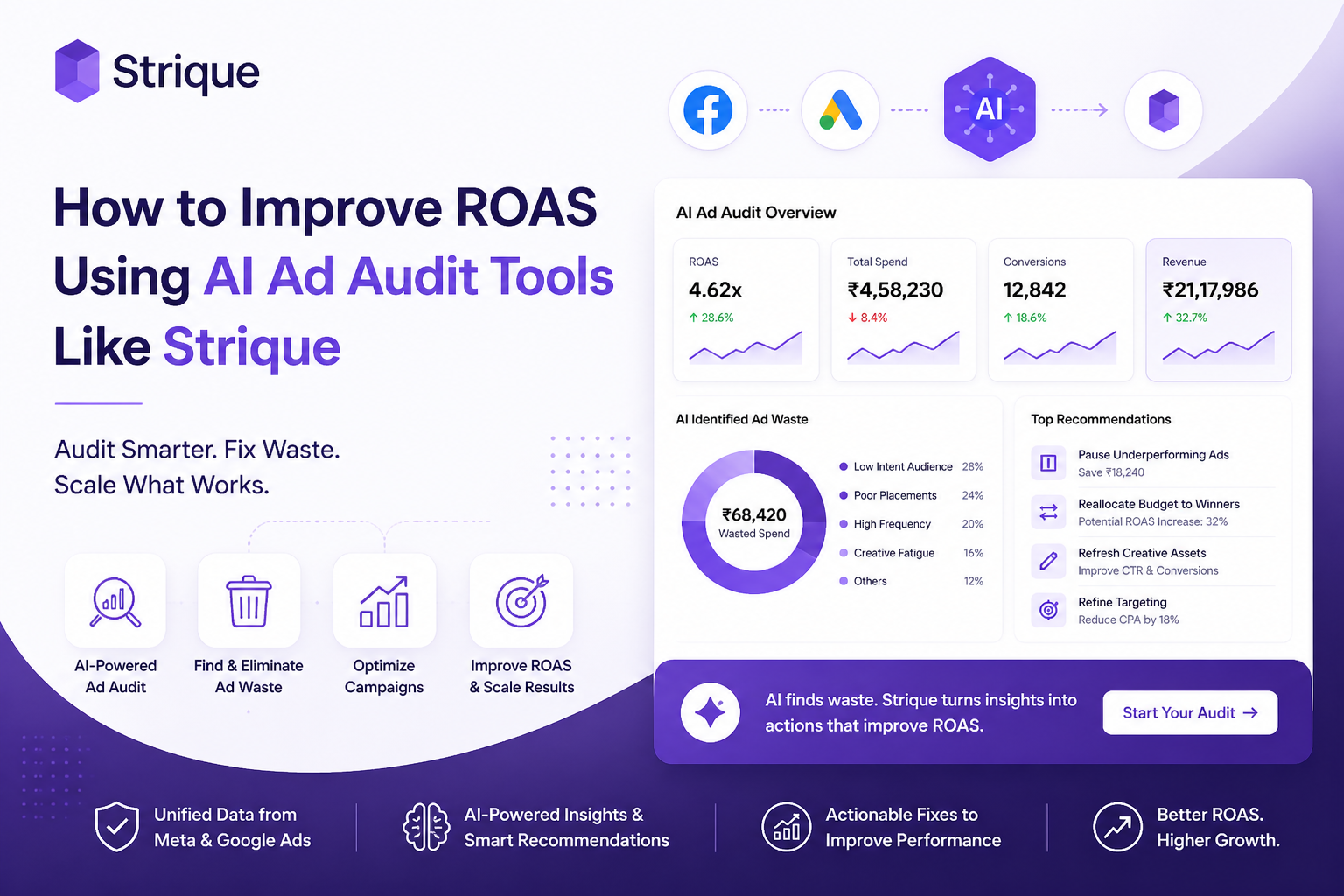
By combining campaign data, product performance, and creative analysis into a single decision layer, platforms like Strique assist marketers in transitioning from reactive repairs to proactive optimization. The platform's positioning is to increase ROAS by transforming dispersed data into actions that may be taken.
Why ROAS declines in the absence of frequent ad audits
Prior to being apparent at the account level, ROAS often decreases gradually. Among the general causes are the following:
- Audience overlap
- Poor relevancy of the landing page
- Inadequate SKU prioritization
- Increasing CPMs
- Errors in the product feed
- Blind areas for attribution
These problems are concealed beneath topline success metrics in the absence of a regular marketing audit.
An ad audit tool becomes crucial in this situation. Rather than focusing solely on spending and income, a robust audit system assesses the following:
- The structure of the campaign
- Duplication of ad sets
- Inefficient placement
- Profitability at the product level
- Conversion declines
- Waste from demographics
- Blockers for landing pages
The quicker these problems are identified, the quicker ROAS recovery starts.
How AI-driven ad audits increase ROAS more quickly
Speed with context is the main benefit of auditing using AI. You might be able to identify the underperforming campaign with a standard audit. By figuring out why, an AI audit tool delves further. It can immediately identify:
- Expensive ad campaigns with poor conversion rates
- Products that receive clicks but no sales
- Winning creatives that are getting tired
- Remarketing pools with excessive funding
- Demographic segments that were wasted
- Poor assisted revenue from high-CPC keywords
This is the point at which an AI tool for ad auditing transcends the role of a dashboard. It suggests the next course of action rather than just merely displaying data:
- Pause inefficient audiences
- Refresh creative hooks
- Expand spending on profitable SKUs
- Exclude low-value placements
- Enhance the consistency of landing pages
- Modify feed titles and images
Stronger ROAS improvements are directly supported by that recommendation layer.
How Strique facilitates the implementation of audits
Fragmentation is the main cause of brands' audit difficulties. Meta is contained within a single tab. Google, Shopify, and GA4 sit elsewhere. Decision-making is slowed down as a result, and optimization cycles are delayed. By serving as an ad audit platform based on uniform visibility, Strique resolves this issue. Meta, Shopify, Google Ads, catalog feeds, and analytics are all integrated into a single AI-powered workflow. Faster understanding of the precise factors influencing or squandering spending is the outcome.
For instance, the platform may surface:
- Ads that are losing money
- SKUs that are not very profitable
- Inconsistencies in the catalog
- Signals of creative tiredness
- Channel-specific CAC increases
- Trends in mixed ROAS
Because of this, the AI platform for ad audit workflow is well prepared for implementation. Strique offers a single decision-making environment intended to increase productivity and cut down wasteful spending, as opposed to requiring teams to manually examine five systems. After utilizing AI-led optimization and feed intelligence, a number of companies on the platform report quantifiable increases in ROAS. Strique is a platform inspired by vibe coding, where you write prompts to generate code, websites, and more. Similarly, vibe marketing lets you write prompts for marketing outputs like ad audits, creative generation, video creation, and more.
The most crucial ROAS metrics to audit
Decision-making metrics, not vanity dashboards, should be the main focus of a robust audit platform. The following are the most beneficial areas:
1. Efficiency of spending to net sales
Teams may see profitability more clearly thanks to Strique's ROAS calculation, which uses net revenues rather than exaggerated gross figures.
2. The velocity of creative weariness
Teams can refresh more quickly if they know when CTR declines before CPA increases.
3. Contribution at SKU level
A robust ad audit platform should determine which goods are affecting blended performance and which could receive additional funding.
4. Leakage of funnels
Mobile friction and checkout exist, and landing page analysis frequently lowers ROAS more than ad performance.
5. Channel overlap
Before budget decisions are made, a modern AI audit platform should demonstrate the interaction between Meta, Google, and retention journeys. Brands can go from reactive reporting to predictive optimization with the aid of these data.
The best way to use AI audits to increase ROAS
This is how the most efficient procedures look:
Step 1: Conduct a thorough account audit
Scan campaigns, creatives, feeds, and attribution using an audit tool.
Step 2: Give budget leaks top priority
Ad sets with high costs and low returns should be fixed first.
Step 3: Extend lucrative SKUs
Utilize feed-level information to scale goods that are already converting effectively.
Step 4: Rejuvenate weary creatives
CTR decay is lessened via AI-driven creative performance analysis.
Step 5: Conduct a weekly audit
ROAS progress is ongoing rather than one time.
Optimization is kept in line with actual market behavior by this recurrent ad audit using the AI platform cycle.
Reducing guessing is now the quickest approach to increase ROAS
Brands require intelligent tools that detect spend inefficiencies, product-level opportunities, and creative weariness before performance deteriorates, rather than depending on delayed spreadsheets and manual evaluations. At this point, decision speed becomes more important than reporting in how to improve ROAS.
By integrating cross-platform visibility, AI summaries, feed intelligence, and actionable campaign recommendations into a single workspace, Strique transforms the audit process into a real-time optimization engine. This unified AI audit platform strategy lets marketers recover wasted spend, improve budget allocations, and scale what is already working for D2C brands growing across Meta, Google Ads, and Shopify.
Seeing the facts more quickly is not a true benefit. It involves being aware of what has to be done next and taking action before ROAS deteriorates even further.
Frequently asked questions
- How does an AI ad audit improve ROAS?
- An AI audit tool identifies wasted spend, weak creatives, poor audiences, and low-converting SKUs faster than manual reviews, helping teams optimise sooner.
- What is the best ad audit platform for D2C brands?
- A strong ad audit platform should unify Meta, Google, Shopify, and analytics data while offering AI-driven action recommendations, like Strique does.
- How often should I run a marketing audit?
- For active paid campaigns, a weekly marketing audit is ideal to catch creative fatigue, spend inefficiencies, and feed issues early.
- Can AI audit tools help product feeds too?
- Yes. A modern AI platform for ad audit can flag title issues, image mismatches, and SKU inefficiencies that impact conversion rates and ROAS.
- What is the first thing to fix in a ROAS audit?
- Start with high-spend campaigns or SKUs that have declining conversion efficiency, as they usually cause the biggest budget leaks first.